In this article
- 1. Words: understood, but not recognized
- 2. Industry vocabulary: when knowing the language isn’t enough
- 3. The promise: same expectations, a different way to present it
- Why AI doesn’t solve the problem
- The method: study the U.S. market before you write
- Write from the market, not from the translation
A good translation has a flaw a bad one doesn’t: nobody questions it.
A mistake jumps off the page and gets fixed. An accurate, fluent, proofread text passes every review, and only fails in the market, when American prospects understand the offer and still don’t act on it.
So companies look for the cause in the offer, the pricing or the targeting, and forget it may be sitting in the copy itself.
It’s one of the most common mistakes we see among French-speaking founders expanding to the U.S., and one of the hardest to spot from the inside, precisely because the translation looks good. Even when it isn’t literal, even when it was handled by AI or by a perfectly bilingual colleague, it keeps the reflexes of the French market, both in word choice and in the way it sells.
The American reader understands what they’re reading, but it doesn’t really land. That gap shows up on three levels, from the most visible to the deepest.
1. Words: understood, but not recognized
The first gap is also the most concrete.
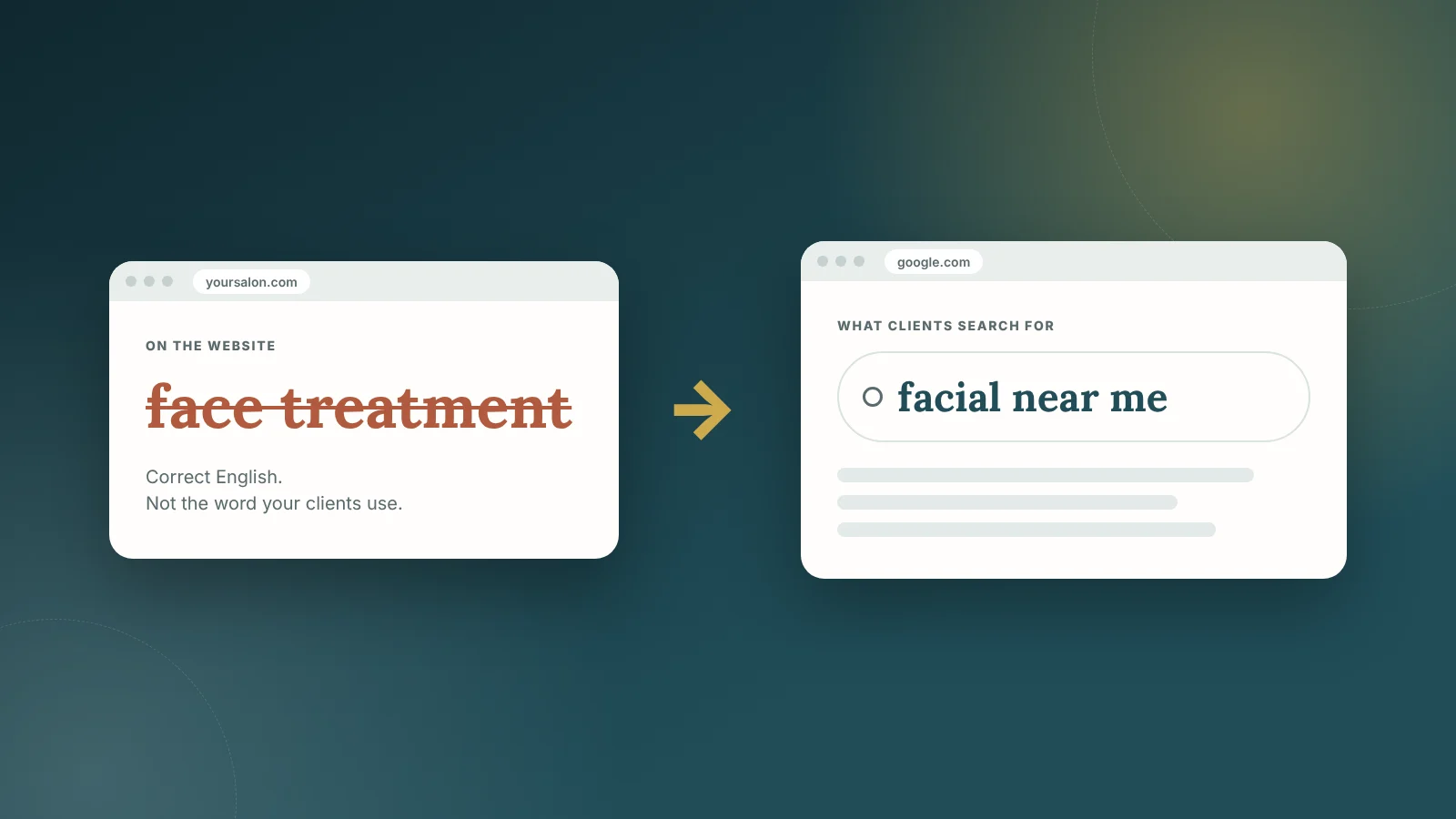
Take a French beauty salon that has opened in the U.S. In France, its signature service is called a soin du visage. On its U.S. website, it became a “face treatment.” Nothing wrong with that linguistically, except that in the U.S., this in-salon service is simply called a “facial.”
The first term is understood. The second is the one people use, and the one they search for.
An American client roughly gets what it means, but she doesn’t find the word she uses with her friends, or the one she types into Google when she’s looking for a salon nearby. So the copy loses twice: it connects less, and it gets found less, because the site doesn’t contain the term people actually search for.
This gap isn’t anecdotal. It can be measured.
In 2021, SearchPilot, a company specializing in SEO testing, published the results of an experiment run for a British e-commerce retailer that also sold in the U.S. The site was already in English. The test replaced British vocabulary with American terms on part of the product pages: “pants” instead of “trousers,” “sneakers” instead of “trainers,” “romper” instead of “playsuit.” Compared with unchanged pages, the updated pages gained about 24% in organic traffic. The original pages had no English mistakes. Their only error was using another market’s words.
Another case study goes further and looks at revenue. In 2022, the agency Builtvisible ran a test for LoveCrafts, a British arts-and-crafts retailer, with a tiny change: replacing the British spelling “colour” with the American “color” in the titles of 874 pages on its U.S. site. Compared with control pages, those pages gained 8% more clicks on non-branded searches, and the agency estimates the revenue impact at 15%. The change came down to a single letter.
Every word, taken on its own, is correct. That’s what makes the gap so hard to see without a close knowledge of the market.
2. Industry vocabulary: when knowing the language isn’t enough
The second gap affects copy you’d think was safe, because it comes from tools or people with excellent English. AI translation is now very good, and a bilingual writer produces flawless English.
But the jargon of a trade or a hobby is learned in the language you practice it in. Someone fluent in English who learned golf or horseback riding in France often knows the technical terms only in French. When writing in English, they pick the right word linguistically, which isn’t necessarily the one practitioners use. AI has the same blind spot: without context, it knows the language, not how people on the ground actually talk.
Golf offers an example. An AI translated the French line “ne perdez plus votre temps au practice” as “Stop wasting range time.” Technically accurate: in French, le practice does mean the driving range. But French golfers also use the word for practice in general, and that’s the meaning the sentence was going for. To an American, the range is where you work on long shots, nothing more.
In technical or enthusiast categories, that detail carries real weight. An expert judges a brand’s credibility by its vocabulary before even looking at the offer, and an approximate term instantly tells them the brand comes from somewhere else. The copy is still understandable, but it loses the credibility it needed to convince.
The same thing happens in B2B. An industrial buyer or a technical lead immediately spots the word that doesn’t sound like what their usual suppliers say, and draws conclusions about how well the company really knows its field.
3. The promise: same expectations, a different way to present it
The third gap goes beyond words. A European client and an American client often want exactly the same service. What changes is how it has to be presented for the promise to land.
French marketing comes from a culture of restraint: it highlights elegance and brand heritage, avoids showing off, and sometimes leaves it to the client to work out what’s being promised. American marketing makes the claim. It spells out what the client will get and puts that front and center. Even in luxury, where nobody shouts, the promise is stated more explicitly.
Erin Meyer, a professor at INSEAD, describes this in The Culture Map: an American audience expects the conclusion, and what it means for them, right up front, while a French speaker tends to lay out the reasoning first. A translated French website keeps that order, which can be enough to make it less persuasive.
In the U.S., the more a brand claims, the more it has to prove.
That assertive style comes with a trade-off. A superlative, a promised result or a claim to be number one calls for a number, a testimonial or a comparison. In France, proof exists too, but it stays more discreet, and the brand’s stature is often enough to carry authority. A translated text keeps that discretion, and an American reader sees claims with nothing to back them up.
A recent J2A Digital audit in the luxury sector illustrates this well. Two companies offer exactly the same services to clients with identical expectations. The first, a European house that has been in the U.S. for years, opens its website on itself: its history, its craftsmanship, its standing in the industry. Its services are presented by name, with an invitation to discover them, and it’s up to visitors to imagine what they’ll experience.
Its competitor, whose site speaks the language of the American market, does the opposite. Every section opens with what the client gets, in the second person: the experience they’ll have, the hassles they won’t have to deal with. Only then does it explain what the company does for them. The tone is confident, the commitments are stated plainly, and the brand doesn’t hesitate to say it does better than others.
- Opens with
- Its history, craftsmanship and standing
- Services
- Presented by name
- Left to the visitor
- Imagining the experience
- Opens with
- What the client gets, in the second person
- Services
- After the benefit, never before
- Tone
- Confident, clear commitments
The underlying promise is the same. But the second is written for an American reader, while the first expects the reader to do the work. In our view, that’s one reason a European company can be established in the U.S. for years without ever truly connecting with its American audience.
Why AI doesn’t solve the problem
You might think AI has taken care of this. It translates far better than yesterday’s tools: the text is fluent, free of awkward phrasing, and reads as if it were written in English. That’s exactly what makes the gap hard to see, even for a bilingual reader.
Without context, AI does what it’s asked: turn French copy into good English. On everyday terms, it usually picks the right word. Its limits show up elsewhere, when a word shifts meaning depending on the industry or the speaker, and above all in the way the copy sells. Ask it for a translation, and it gives back the order, tone and promise of the French original. The result is a flawless version of French logic, with the same blind spots as the source.
The golf example shows it. Faced with what looked like a false friend, the AI chose the most precise term for the place, and missed the meaning of the sentence. Its translation was more sophisticated than a beginner’s, and yet less accurate.
AI remains an excellent writing tool, as long as you don’t ask it for a straight translation. Giving it market context (the industry, the American target audience, the terms used by local competitors) clearly improves the result. But a few lines of context won’t get it to find an industry’s exact word. You have to iterate, test its suggestions against what market players actually say, then have the copy reviewed by an American who knows the field. No tool flags this kind of error: it takes an American practitioner to hear it.
And that context isn’t found in the French text. It’s built by studying the American market.
The method: study the U.S. market before you write
To get copy that resonates, start from what American competitors are already saying, wherever they say it, rather than from the French text. Choose them carefully: the benchmark is established American players, not other French companies that arrived before you and may have made the same mistakes.
Each source tells you something different.
| Source | What it reveals |
|---|---|
| U.S. competitors’ websites | The promise they lead with and their brand vocabulary |
| Google search (keywords, suggestions) | The words customers actually type |
| Customer reviews (Google, Amazon, Yelp, depending on the industry) | Customers’ own words, and what they really remember about an offer |
| Competitors’ ads | The promise they invest in, so the one that converts |
| Social media and influencers | How customers and the community talk, jargon included |
| AI answers | How the category is described, and which brands get mentioned |
| Trade shows and industry events | The vocabulary people actually speak, not always written down |
| A conversation with an American in the industry | Their gut reaction: what speaks to them, what sounds off |
On websites, look at how the promise is worded in headlines, the order in which arguments appear and the words that recur from one competitor to the next. On Google, search suggestions and keywords show how customers phrase their needs, often in different terms than brands do. Reviews go further: they show the words a customer uses to describe what they bought, and what won them over.
Ads deserve special attention, because a competitor doesn’t keep paying for a promise that doesn’t convert. What they highlight in their ads, and especially what they repeat, tells you what works in this market.
Social media and industry influencers give you access to customers’ own language, shortcuts and jargon included. AI answers, for their part, show how the category is described and which brands come up when a buyer asks.
The last two sources take more effort and aren’t always available. A trade show or industry event lets you hear the vocabulary as it’s spoken, including what never makes it into writing. A conversation with an American professional in the field brings a perspective no online analysis can replace. The goal is less to have them edit your copy than to capture their reaction: what speaks to them, what sounds off, what they expected to read.
Then cross-check those findings against the three levels of gaps. For every term, every argument and every promise in the translated text, the question is the same: is this how the American market talks about it? Every gap you find becomes something to rewrite.
Write from the market, not from the translation
Put together, these three gaps explain how an accurate translation can hold back a company’s growth in the U.S. The site gets found less, because it doesn’t use the words the market searches for. It seems less expert, because its vocabulary gives away that it comes from somewhere else. And it persuades less, because it presents its promise the way you would in France. None of these effects is visible when you read the copy, which is why the cause is so often sought elsewhere: in the offer, the pricing or the targeting.
A company launching in the U.S. needs less a better translation than copy written for readers who have never seen the French version. That changes the order of operations: instead of starting from the existing site and converting it, you start from what the American market says and expects, then you write. If AI is part of the writing process, that context is what you give it, alongside the original text.
It takes longer than a translation. But it’s what allows the site to do its job with an American buyer: make them want to take the next step.
Was your U.S. website written for the American market, or translated from French?
J2A helps French-speaking founders grow in the U.S. We test your website against what your market actually says, then rewrite it for your American buyers.
Contact J2ASources
- SearchPilot — SEO impact of localization: swapping UK and US English, March 2021.
- Builtvisible — How SEOcausal turns small changes into big results: localisation, September 2022.
- Erin Meyer — The Culture Map: Breaking Through the Invisible Boundaries of Global Business, PublicAffairs, 2014.